Acquired Skills

This slideshow requires JavaScript.

“I need a pilot program for a B 212 Helicopter.” Trinity yells into her phone as we stare at a giant military transport atop a Manhattan skyscraper in the first Matrix movie.  Ten seconds later, we are whisked away as Trinity expertly pilots the ship above the city.  Similarly, I dialed up my iPhone to figure out how to rent a “motobike” in Trinidad, Bolivia.  Though Trinity learned a year’s long process in a matter of seconds, I only learned the word for “to rent,” but the result was the same.  I hopped on the moped and rode off into the Amazonian swamp that is eastern Bolivia.

I had come to Trinidad to catch a boat up the Rio Mamore, hoping for five lazy days of jungle scenery before arriving at the Brazilian frontier.  Though I failed in that goal, I succeeded in adapting to the ways of the locals, without computer inputs.

Shortly after speeding away from the leafy town square on my newly acquired wheels, I realized I didn’t know how to start the thing once I turned it off.  The older, to overstate his position, rental agent, had showed me how to steer and change gears, but he neglected to show me out to get from off to on.  Despite this misstep, I fought the throngs of fellow riders and rode past the town’s fruit market on my way out of the city.

My first stop for the day was the riverside town of Puerto Almacen, home to dozens of fish shacks on stilts and my presumptive boat to Brazil.  As ordered by Lonely Planet and my host mother in Santa Cruz, I went straight to El Capitania, some sort of naval base for the riverboats, but that stop was useless.  The man sitting out front said I had to find a captain willing to accommodate me.  The muddy track leading to the rio looked like it would swallow a moped, so I left the bike behind.  Before walking off, I looked back apprehensively wondering just exactly how I was going to get it started again.

A collection of ten barges sat tied up along the opaque river, which was about 100 yards wide and flowing fast but level.  Over the top perched a long bridge, the only one for miles in either direction.  Most of the boats were empty, but three barges, mostly just platforms of plywood, sat at the bottom of custom rigged ramps receiving newly filled propane tanks.  Obviously leery of lounging alongside propane – Bolivian filled propane, I nonetheless trudged ahead, asking away in my broken Spanish, if I could accompany the propane to Guayaramerin.  The captain seemed amenable, but the propane wouldn’t be ready for at least four days.

Next, I found some American engineered coca cola, covering 5 barges and employing several crewmen. The captain wasn’t around, but the young men who lived on the barges said I should come back at 2:00.  The last boat in the port belonged to the Bolivian navy.  One young man, who had worked as a Mormon missionary in Illinois, told me that yes I could go along and that the boat might be leaving as early as the next day.  Ecstatic, I decided to drive around as I waited for Captain Coke to return.

After a brief lunch of some sort of fried fish, ten feet above river plane, I trudged back to the moped.  I pushed the button on the right handlebar, but it didn’t start.  I pushed every other button on the handlebars, resulting in a blinking, honking, nonstarting moped.   I looked down between my legs, and conveniently, Honda had spelled out in English how to start the bike.  After opening the choke valve, I had to kickstart the bike to life.  I had no idea where the choke was, but luckily the bike caught after jumping on the starter three times.

To fill the afternoon lull, I rode past the airport north of Trinidad, which is mostly just a collection of dirt streets and small stores, in search of a wildlife sanctuary that Lonely Planet convinced me existed.  Feeling good about the moped, I opened it up until the engine sounded spent.  Of course the gas and speed gauges had long since stopped working, so I had to drive by feel hoping I wouldn’t run out of fuel.  Supposedly the wildlife sanctuary lay 14 kilometers past cornfields and cattle yards, so I was lost in my thoughts, when an abandoned Boeing 727 leapt into view, sitting in a field no more than 100 yards from the road.

Lacking Trinity’s summoned expertise, the shock of the plane’s appearance and the one coming in for a landing above, startled me out of my daze.  I grabbed the handbrake, but I also accidentally twisted the throttle, so the bike lurched ahead.  With all the leverage on the right handlebar, the bike twisted to the left.  Just before the bike ended up on its side on the highway, I stomped on the footbrake with my right foot and braced the ground with my left.  I let go of the handle and prevented another wreck from accompanying the fuselage.

But there was a Boeing 727 sitting in a field in Bolivia.  I felt like I really was in the Matrix now.  I hopped off the bike to take some pictures of the plane, and found a path leading straight to the jet.  This time I wasn’t worried about restarting the bike.

After dodging various puddles and scanning for snakes, I hopped on the plane’s wing and peered into the abandoned transport.  The interior had been stripped of every usable part, containing only a wooden floor and holes for windows.  I hopped inside, wondering if a serpent was waiting for me in the bathroom.  When I looked out the far side of the plane, I saw nothing but Bolivian farmland just like Neo saw nothing but a sea of human bodies, wondering just what exactly was going on.

Leaving the plane, I got back to the motobike just as an aging soldier, dressed in full camouflage and wielding a machete, pulled up on a bike.  His motorcycle arrived in a hurry, and he hit the brakes just as the plane appeared in his sights.  Luckily, I was mid kickstart, so I simply nodded hello as he stopped and I pulled away.

Later I found out, in 2011 a flight was coming in for a landing at the Trinidad airport and lost power a few miles before it reached the runway.  Everyone on board, 155 people including a Bolivian senator, had survived.  But the plane had been left to rot, or perhaps become a tourist attraction.  I wonder how the arriving passengers above felt about approaching over a crash site.

Eventually, I returned to the docks and found out none of the boats would be leaving any time soon.  So I booked a bus headed for another jungle town, from where I could take a tour of the amazon.  With all my errands accomplished, I relinquished the keys to my bike.  As I walked down the dirt streets back to my hostel, I looked longingly at the dozens of motobikes in the streets, but I knew I was headed back to the real world, where my newly acquired motorcycle knowledge wouldn’t count for much.

Choose Your Own Adventure

This slideshow requires JavaScript.

Lazy but craving adventure, I opted for the 1000 feet long railway bridge that was missing half its planks.

Charles Darwin was not impressed with his trek to the highest peak in the Western Hemisphere.  “The scenery thus far was very uninteresting,” he wrote of the behemoth’s outlet valley.  He was so unimpressed, that he didn’t bother to mention Mount Aconcagua in the Voyage of the Beagle, leaving his description for an appendix.

Given the “scene of desolation” as Darwin called it, was there really much to experience in the Uspallata Pass that connects Santiago, Chile, and Mendoza, Argentina?  More than anything else, the two days I spent exploring the area taught me that, sometimes you have to create your own adventure.

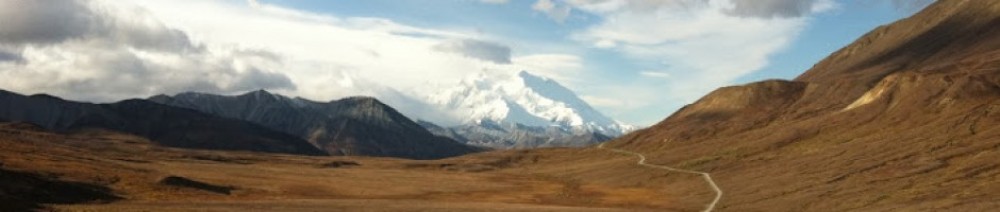
Not being a mountaineer, I was wondering just exactly why I should visit Aconcagua.  Eventually, my nostalgia for Mount Denali propelled me to its base.  Having spent a week in Alaska for a friend’s wedding, I extended my trip by four days to hike in the mountain’s namesake park.  The experience of creeping around a mountain pass on a gravel road in a rickety old bus, and suddenly finding America’s largest mountain radiating in sunlight, stunned me.  I was hoping to recreate that experience in South America, but I soon learned it would be impossible.

The Uspallata Pass is one of the busiest routes between Chile and Argentina, connecting the Pacific nation’s capital with Argentina’s wine center.  A two lane road rises out of the Mendoza desert, ascending canyon walls for 215 kilometers to the 12,500 feet Chilean border.  The route contains some of the most popular attractions in the country including  Argentina’s biggest ski resort, the Mountain of Seven Colors, a natural bridge, and the aforementioned Mt. Aconcagua.

The Mountain of Seven Colors lies a barren 10 miles to the east of the town of Usapallata along a hint of a dirt road.  To make viewing it an adventure, I decided to bike the route and climb on top.  And to attain the necessary level of risk, I had allowed my travel insurance to expire the day before.  Though the ride was just ten miles, the terrain required an ascent of 2000 dusty feet.  After ten or fifteen dirt bikes and dune buggies cruised around me, I finally made it to the mountain’s tiny parking lot.  Though its characterization as a “mountain” proved misleading, the setting sun behind me lit up the rock formation’s glittery layers of greens and reds.  And the perfectly level top, without easy access, attracted my climbing legs.

Locking the bike, I ran up the gravel slopes, looking for a place to climb on top.  At 10,000 feet, I was promptly exhausted.  Eventually I found a place where, if I left my backpack behind, I could scramble atop the alien landing site.  The views to the Chilean border, with Aconcagua showing its snowy tip behind a short range of closer peaks, rewarded my self-inflicted adventure.

The next day I hopped on a bus to view the ancient bridge and climbing mecca.  By this time, I knew Aconcagua wouldn’t deliver like Denali, but I was still hopeful.  The reason Denali lights up the senses is that it’s the only mountain in sight.  The peak’s giant base stretches for miles.  Standing at 3,000 feet, looking up at a 20,000 feet mountain, you contemplate existence.

In contrast, to reach Aconcagua, the road itself passes by at 8,000 feet, and the giant’s surrounding mountains nearly reach its shoulders.  Instead of four hours on a narrow gravel road, an hour long stroll through the nearly deserted valley delivers you at its feet.  By the time I had reached the park’s limit, I had barely broken a sweat.  To turn this leisurely outing into an adventure, I ran ahead of the other bus tourists and climbed the 45 degree canyon wall of loose shale to find a perch suitable for consuming my lunch.  Hanging 50 feet above the valley, with the mountain to myself, my peanut butter sandwich almost made me reminiscent of Alaska.

But the adventurer in me was hardly satiated.  Five kilometers downhill from Aconcagua sat Puente del Inca, my last potential adventure.  Though it sounds exciting, it becomes less so after learning the British built a VIP bathhouse nearby and paved over the bridge with asphalt.  Darwin was disappointed too, writing, “The Bridge of the Incas is by no means worthy of the great monarchs whose name it bears.”

With several hours to spare, and not much adventure too look forward to, I hiked down the narrow valley between the mountain and the monarchs.  Just before the landmark came into view, I was left with three choices to cross the same stream over which nature had already laid itself.  The international roadway crossed a modern bridge and carried a sidewalk.  Next to it lay a decades old railroad bridge with a leaky pipe running across it.  And hundreds of feet below, lay the ancient roadway that Darwin himself probably used to cross the stream.  Lazy but craving adventure, I opted for the 1000 feet long railway bridge that was missing half its planks.

Luckily, some industrious resident of Puente del Inca had installed a handrail across the bridge, making it easier to repair the pipe.  For the first two thirds of the bridge, which was about fifteen feet wide and sturdy against the wind, someone had laid wooden 2 x 12s atop the underlying trestle.  Holding on to the railing, I slowly tiptoed across the boards which, though new, remained unfastened.  Halfway through my tightrope, I looked back as apprehension started to build in my chest.  After another 100 feet, I remembered once again that my travel insurance had expired.  Then another 100 feet, “Isn’t it Mother’s Day?”  Finally, with the last section in site, I came to a gap in the bridge.  My reliable wooden platform had run out, and I was reduced to crawling across the steel rails and their supports with three feet of air between each one, stretched above the stream hundreds of feet below.

Though terrified, I smiled to myself, realizing I had finally found an adventure befitting the tallest peak in the Americas.  Stunned for a few seconds, I took a deep breath, and slowly stepped across the last open air between me and my destination.  Once I returned to the wooden supports , I ran off the bridge gasping for air.

Though interested in the natural bridge, I found myself agreeing with Darwin, let down by the monument.  After analyzing it from every angle, I found a comfortable café in which to spend my final hour before my bus arrived.

Standing in the windy parking lot, with the sun setting and the cold settling in, I was looking forward to heading down the mountain to my warm hostel and an Argentine steak.  Darwin, too, knew this is what really made travelers satisfied after seeing the valley:

“The extreme pleasure, I suspect, is chiefly owing to the prospect of a good fire and of a good supper, after escaping from the cold regions above: and I am sure I most heartily participated in these feelings.”  On nearly every aspect of this region, Darwin and I agreed.

#runningproblems


In Vicuña, Chile, I woke up in a hostel run by a grandmotherly German woman named Rita and her poodle, Blancita.  Part of the enormous German breakfast she offered included fresh avocados which have never agreed with my stomach.

Blancita

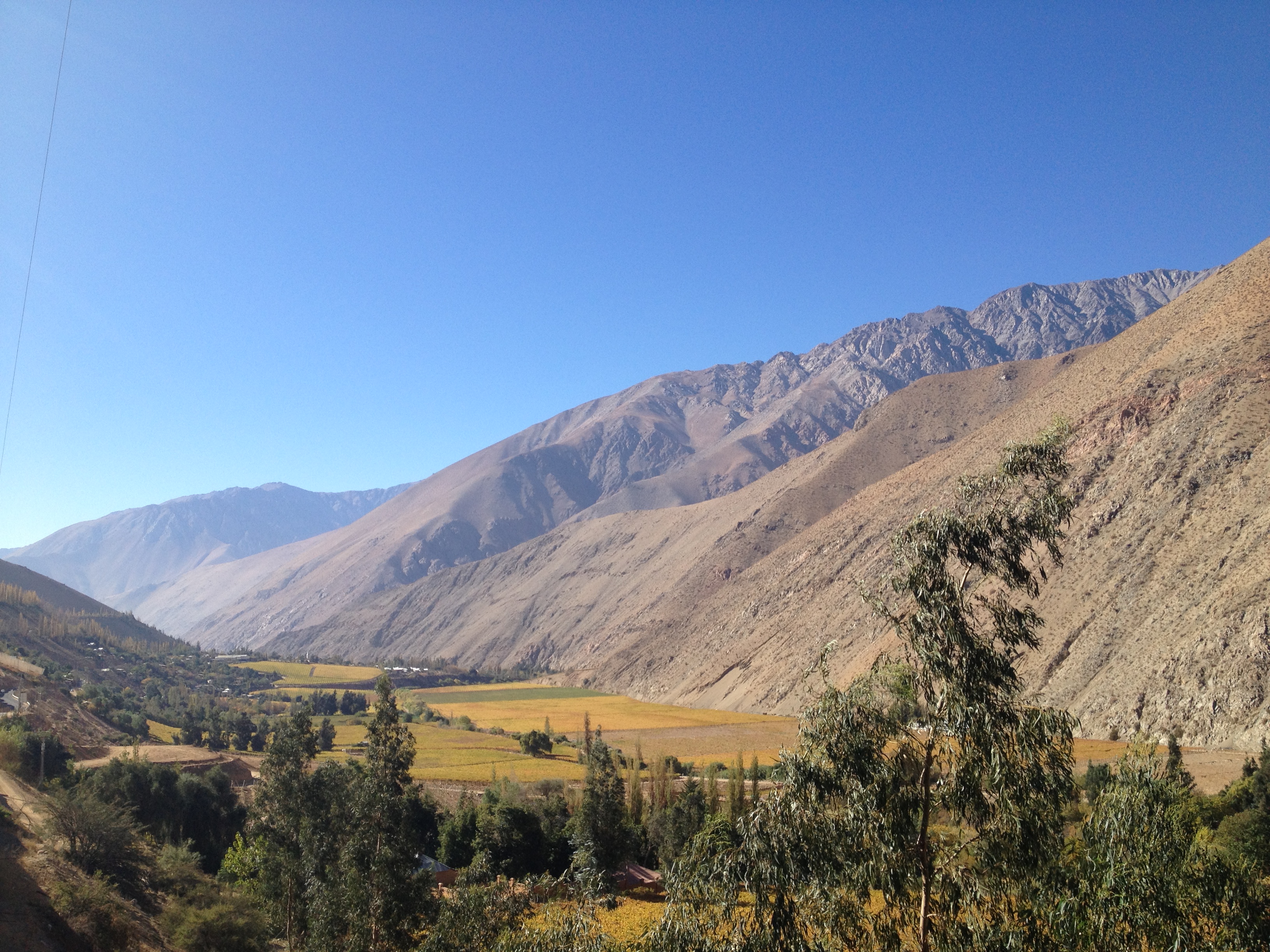
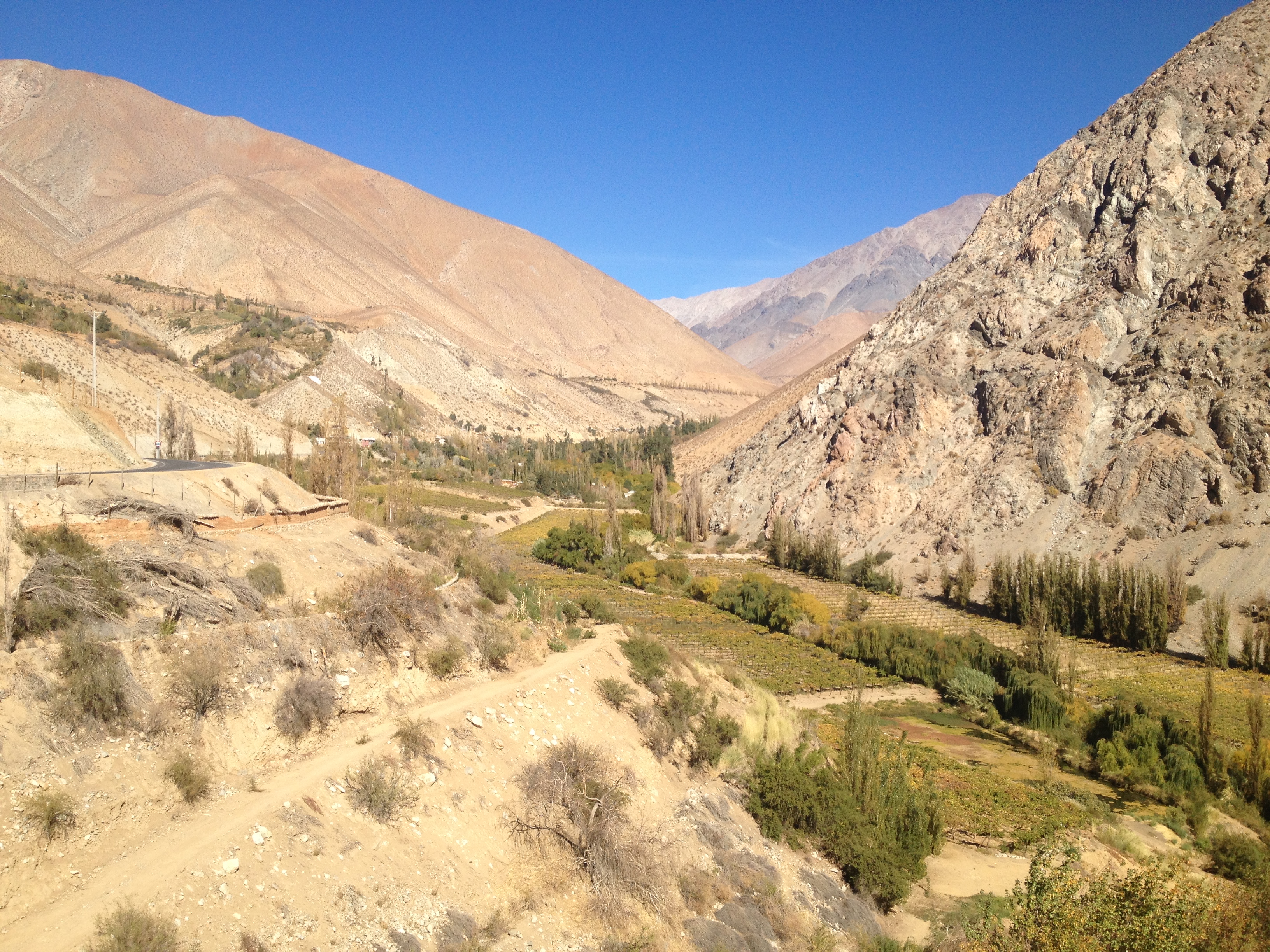
 After putzing around the town for a couple hours, I finally got the bus to Pisco Elqui, from where I started running through a desert river oasis.  The small desert town of Pisco marks the beginning of a long desert canyon where barren mountains descend to meet a tricking stream, the remains of Andes snowmelt.  Ten kilometers farther up the valley, an artist’s market beckoned me.  Starting out from Pisco, I had an iPhone on my arm and a large bottle of water uncomfortably passing between my hands.  The white long sleeve t-shirt beneath my red shirt, eventually became a sun blocking burka.

Pisco Valley

 After an hour of running, the market came into view.  Coming up the last hill, a voice from beneath a giant poplar tree yelled, “where are you from?”  A man, who was about three feet tall in a yellow cava shirt, repeated the question louder so I could hear him.

I turned off This American Life, and “took a shadow” as the man, who had maybe two or three teeth left, instructed.  He had lived in New Jersey for eight years but now lived in the Elqui Valley, I presume to cash in on the area’s legendary “energy.”

Enjoying the conversation, we were interrupted by a tall, long-haired drunk man.  In highly accented Chilean Spanish, he joked about my running stride and admonished me to adjust my gait.  He demonstrated how to make the change, reenacting a movement reminiscent of Roal Dahl’s BFG.

IMG_3864

Nonplussed, I excused myself and jogged down to the market.  In search of the banos, I found their demure outpost.  Saved from paying the 200 pesos by an inattentive attendant, I perused the toilet.  Running water but no paper.

The leaves from the shady trees behind the bathroom appeared innocuous.  I tore a couple off and rubbed then on my arm, testing their proclivity for inflicting discomfort.  None resulted, so I returned to the bathroom to do my business.

Subsequently, the 6 mile run back to Pisco was perfectly pleasant.

 IMG_3878

Running the Rio Colorado

This slideshow requires JavaScript.


Five feet into a fifteen foot vertical climb, I looked down past my quivering feet and contemplated why exactly I was trying to climb over the top of this nearly vertical ridge.  Clouding my thoughts, the late winter sun had long since vanished over the desert canyon wall leaving me wondering just exactly how long I had before darkness set in.  Amidst this stressful calculus, I remembered how just two hours before, I had been sitting on a cafe patio, enjoying a coke with two newly befriended Argentines.  Starting to lose my drive, the challenge laid out for me by the director I had passed on the trail rang out in my head, “You’re definitely not making it out of here before dark, there’s no question about that.”

In need of fresh air, one recent Saturday morning I jumped on a bus headed for Cafayate, Argentina, journeying four hours through a beautiful desert canyon to a mountain oasis of 10,000 people.  From the moment I woke up, things went my way.  Fighting through a pre-dawn fog on my long walk to the bus station, a car pulled alongside me, and a man in his 60s offered a ride to the terminal.  Abandoning the number one rule parents lay out for their children, I hopped in the car.  Carlos was on his way to church from his pasta factory, and decided to give me a ride.

ONE of my most prolific traits is that I put up a barrier that prevents most people from entering my world.  While its pretty strong when I’m in a comfortable setting, its thickness doubles when I travel.  As a result, I have a hard time letting down my guard enough to meet locals and enjoy a culture.  After having dinner with a fellow traveler, who had befriended folklore musicians and tango dancers, I knew this had to change.  That Saturday, apparently, was the day to open up, and also the day to make me learn Spanish.

Stepping off the bus into the deserted streets of Cafayate, I started trudging towards the town plaza in search of a place to stay.  Alejandro and Claudio spotted my indecision, and sent me in the right direction.  I heeded their advice, dropped my stuff at a hippy hostel, and I was back having a drink with them in 30 minutes.  Tranquilo was the word of the day, describing perfectly the pace of life of this small town of unpaved roads, unlocked bikes, and unassuming residents.  Tranquilo also described Claudio’s approach to life, who I came to understand, didn’t do anything quickly.  Learning I was from the U.S., Claudio, with long dark hair and few teeth, reminisced about an old girlfriend, Cassandra, who now lives in Oregon.  Alejandro, who looked like a linemen, told me he thinks the local army officers that patrol the streets look like smurfs in their blue uniforms.  After finishing Alejandro’s sandwich and Claudio’s coke, I excused myself to figure out how to hike to the Colorado River.

Thirty minutes later, I had changed into running clothes and was walking down the gravel roads in search of a canyon.  Lonely Planet had made the canyon sound, tranquilo, only mentioning a swimming hole, so I limited my supplies to running shoes, a phone, and a jug of water, figuring it’d be like a long run.

After an hour of walking, I reached the entrance to the canyon at about 4:20.  Instead of a remote outpost, the canyon climbed up from a small indigenous settlement guarded by one of its residents.  Asking where I was headed, the man looked at his watch, and shook his head.  He was not amused when I suggested I could run up the canyon.  Dispensing with subsequent conversation, he ordered me on: Go!

Well aware of the receding sun, I scampered over the riverbed’s boulders as fast as I could, trying to hold on to my jug of water as I crossed the stream again and again.  By 5:00, I still had not glimpsed the destination waterfall, and I was starting to worry about the sun.  Two men came down the trail towards me, and I fortuitously stopped to ask them how long it was to the waterfall.

The director, I call him that because he said he was in town to work on a movie, and I thought he looked like the director, spoke fluent English and described the hike to me. I had to hike up and over a ridge and then descend to a viewing point of a small waterfall.  From there I had to hike behind me around the ridge to the higher cascade.  I didn’t understand it either, but I decided to go ahead anyway.  Also fearing the setting sun, the director cut three patches of glow-in-the-dark tape from a long roll he carried.  He told me to mark my path with the tape so I wouldn’t get lost. And that’s when he put down the challenge to which I course had to respond.

After departing the film stars, I came upon a ridge with a vague trail leading up over it.  Taking it for the one described, I started climbing the vertical face.   This was the cliff, where five feet into it, I reached a point where I needed both hands and could no longer carry my water bottle.  At that point, I set down Dan’s rule number four of outdoor adventures.  If I had to climb a wall up which I could not carry a water bottle, I probably shouldn’t climb the wall at all.  I retraced my steps, found another way around the ridge, and continued up the canyon.

At 5:20, the setting sun, rising wind, and depleted water finally clued me into the situation.  I decided that at 5:30, waterfall or no, I had to turn around.  Abandoning the rule I had set earlier on the hike, I had to throw my water bottle ahead of me at one point, so I could get scramble down a rock face.  At 5:28, I reached a small ridge in the middle of canyon.  Resigned to climbing it for my last view, I got to the top and a waterfall stared me down!  Elated I ran up to a viewing point, waited for two or three seconds, and turned around to begin what I believed would be my hike down.

Instead, I had found the path to the other waterfall which is set under a ridge and only accessible from the upstream direction.  The director’s directions couldn’t have been better.  But now it was 5:45, the hike to this point had taken me over 2 hours and the sun would set soon after 7.  Taking pictures as fast as I could, I hiked back up the ridge and down the canyon, agape at the surrounding views.  The director called it National Geographic in real life.

As I reached the mountain settlement, a herd of goats shrieked to me in greeting.   Despite the director’s promise, I made it out of the park with just a few minutes of daylight to spare and began the long walk back to my hostel, covered in scratches from unforgiving cacti, darkness settling in around me.

SHIPPING DESTINATION ARRIVED TO PLANT

This slideshow requires JavaScript.

“No, you can’t take your bike on the bus.”  I wish I had heard such an utterance only once or maybe just twice in the last three months, but the frequency with which this crushing blow settled on my ears, constantly left me reeling.

In 2012, as I planned my bike ride through South America, the one limiting factor I didn’t even consider was the inability to bring my bike on long distance buses.  In the US, my limited experience with bus travel stems from the many revenue hungry companies that ply the northeastern seaboard with cavernous cargo compartments and agreeable drivers.  But that limited experience proved misleading for South America.

Now that, according to the Chilean Post Office, my bike is at the “SHIPPING DESTINATION ARRIVED TO PLANT” at the Santiago airport on its way to my brother in Tacoma, I can look back and evaluate my decision to bring the bike with me on the trip.

Biking Across a Continent

Thousands of bikers every year cycle across the United States.  Usually it takes between two and three months, and bikers tackle the route in the warm summer season.  Such a trip sounds predictable and enjoyable.  Instead, what I envisioned for South America would be like trying to bike to every single major tourist attraction in the United States, from the Californian coast to the Maine wilderness via Miami and Montana.  Such a trip would take months or even years, and would lose its focus along the way.  Alas, that is what happened to me in South America.

Upon arriving in Buenos Aires, I envisioned busing along the East Coast of Argentina, through Patagonia, and up to the Argentine Lakes District.  From there, I hoped to combine busing and biking, making my way north across Argentina and into the Altiplano of Chile and Bolivia.  However, I discovered a number of things along the way, which in the end, resulted in parting with my bike.

The moment I decided to mail my bike home, I was having one of the best bike adventures of my trip.  Leaving Cordoba, Argentina, I had set out on a four day tour of the mountains and Jesuit estancias surrounding Argentina’s second biggest city.  The ride could not have gone better.  After the first day finished smoothly, with blue skies an intermittent traffic accompanying me, I set off on the second day unencumbered by doubt.

Lost on my way out of the small town, two local mountain bikers stopped to give me directions.  I rode along with one for ten minutes before he rode ahead to catch up with his friends.  After an hour of cycling, I caught up to his son who was clearly struggling in the early morning hours.  After ten miles, we reached a junction where Dad threw his sun under the bus: “Too much beer last night!”

After the delightful introduction to my day, I began climbing 1000 vertical feet to a panoramic view of an enormous lake resting beneath 6000 feet mountains.   For the next hour I coasted along the lakeshore, alternating between agonizing ascents and rambling declines.  After two hours of riding, I left the lake, and followed a level, country road, with barely any traffic to interrupt the pastoral ideal.

And even in this wonderful setting, where the trips, both the macro and micro, were playing out as planned, I realized I didn’t want to bike around South America.  Here I was, ten miles and an hour from a small town in rural Argentina.  Sure, the hostel was nice, and the nearby hiking was fun, but I was thousands of miles from Machu Picchu and months away from Ecuador.  With all of the amazing sites ahead of me, why was I biking through this average scenery?

And that’s when I decided I no longer wanted to bike around South America.  For the most part, I simply wanted to see more interesting things faster.  But the annoyances of trying to carry a bike with me didn’t help either.  An American cyclist I met, who biked 8,000 kilometers in South America, said it best: “I love biking, but when you’re NOT on the bike and trying to get it around with you it’s a major PITA.”  To list just a few of those pains:

  • Every bus company charged me to take the bike along with me.  I’ve been on 30 buses in South America, and I’ve carried my bike on 10 of those.
  • For every bus ride, I had to completely dissemble my bike and pack it in a box.
  • For every hostel, I had to find somewhere to store my bike.
  • When packing my bike, I had to track down a bike shop to give me a bike box.
  • Every time I arrived in a new city, I had to reassemble my bike in the bus station while guarding everything I owned.

In the end, I’m happy my bike is on its way to Washington.  But I’m also happy I brought it with me.  Having a bike allowed me to complete some of the best parts of my trip.  Cycling through the infamous Seven Lakes in Argentina was one of the most beautiful trips I have ever done.  Biking in the Argentine highlands near Mendoza, with America’s largest peak staring out of me, is something I’ll never forget.

I’m excited to do another bike tour.  Whenever I do make it back the US, I plan to bike from Seattle to the Yukon.  But now I know to focus my path, and enjoy the ride for the ride’s sake.  That way, I’ll never have to take the bike on another bus, and risk hearing those awful words again.